How Social Media Algorithms Are Changing Digital Marketing in 2025

0
social media algorithms

Introduction

In 2025, social media algorithms continue to play a central role in shaping the landscape of digital marketing. As platforms such as Facebook, Instagram, TikTok, and LinkedIn continue to evolve, their algorithms are becoming more sophisticated, influencing how businesses reach and engage their audiences. Understanding how these algorithms work is crucial for marketers looking to stay ahead in an increasingly competitive digital space. In this article, we’ll explore how social media algorithms are changing digital marketing, the latest trends, and the strategies businesses need to adopt to thrive in 2025.

The Evolution of Social Media Algorithms

Over the years, social media algorithms have evolved from basic chronological timelines to more advanced systems that focus on personalization, engagement, and content relevance. The rise of AI and machine learning has made these algorithms smarter, allowing them to better predict what content will resonate with users.

Key Developments in Social Media Algorithms:

  • Personalization: Algorithms now prioritize content based on individual preferences, behavior, and interactions, ensuring users see the most relevant posts.

  • AI and Machine Learning: These technologies enable algorithms to continually learn from user behavior, improving the accuracy of content recommendations over time.

  • Engagement Metrics: Metrics such as likes, shares, comments, and time spent on content are increasingly important in determining what gets shown to users.

  • Content Type Prioritization: Algorithms now give more weight to video content, live streaming, and interactive content, reflecting shifts in user behavior and preferences.

How Social Media Algorithms Are Shaping Digital Marketing in 2025

As we enter 2025, social media algorithms are influencing how brands approach digital marketing, forcing businesses to adapt their strategies to optimize visibility and engagement. The way businesses interact with their audience, measure success, and create content is fundamentally changing.

1. Content Personalization

In 2025, social media algorithms are increasingly personalized, allowing businesses to deliver highly relevant content to their target audience. Personalization goes beyond just targeting based on demographics and location; it now takes into account user behavior, preferences, and even the time of day when a user is most active.

  • Dynamic Content Delivery: Algorithms personalize the content feed in real-time based on individual interactions, interests, and behaviors.

  • Behavioral Targeting: Businesses can now segment audiences based on their past interactions with content, allowing for more refined targeting.

  • Predictive Analytics: Predictive algorithms help brands anticipate what type of content will engage users before they even engage with it.

Action Step: Focus on creating content that speaks to the unique needs and behaviors of your target audience. Use social media analytics tools to track performance and adjust your approach based on real-time data.

2. Video and Interactive Content Dominate

Social media algorithms in 2025 favor video and interactive content, reflecting the growing trend of user preference for more engaging formats. Platforms like TikTok, Instagram, and YouTube have already proven that short-form video content garners more engagement than static posts.

  • Short-Form Video: Platforms like TikTok and Instagram Reels prioritize short, engaging video content that captures attention quickly.

  • Live Streaming: Live videos receive higher engagement rates and are promoted more prominently in feeds.

  • Interactive Features: Features such as polls, quizzes, and live chats help increase user engagement, pushing content higher in algorithmic rankings.

Action Step: Invest in video production and interactive content to stay relevant. Consider creating short-form videos and engaging live streams that encourage real-time interaction.

3. The Role of Influencer Marketing

In 2025, social media algorithms continue to amplify the effectiveness of influencer marketing. Algorithms prioritize content that generates authentic interactions, and influencers often can foster this type of engagement with their followers.

  • Increased Authenticity: Micro and nano-influencers are becoming more valuable as algorithms prioritize authentic and meaningful interactions over sheer numbers.

  • Content Collaboration: Collaborating with influencers allows businesses to create content that resonates with niche audiences, often resulting in higher engagement rates.

  • Algorithmic Amplification: Influencers’ content is often shown to users more frequently due to the trust and interactions their content generates.

Action Step: Consider building partnerships with influencers who align with your brand’s values and target audience. Focus on long-term collaborations rather than one-off promotions to build stronger relationships with followers.

4. The Shift Toward Paid Advertising

While organic reach is still important, paid advertising is becoming a more integral part of social media strategies. Social media algorithms now often limit the organic reach of business pages, making it necessary for brands to invest in paid ads to maintain visibility.

  • Targeted Advertising: Paid ads are more targeted than ever, with algorithms allowing businesses to hone in on specific user behaviors, interests, and demographics.

  • Higher ROI: With advanced targeting, businesses can achieve a higher return on investment by reaching the right audience with the right message.

  • Ad Formats: The rise of native ads, stories, and in-feed ads has transformed the way businesses advertise, blending more seamlessly with user-generated content.

Action Step: Allocate a budget for paid social media campaigns and experiment with different ad formats. Continuously test and optimize campaigns based on performance metrics.

5. Social Commerce and E-Commerce Integration

Social media platforms are increasingly becoming shopping destinations. In 2025, social media algorithms are facilitating the growth of social commerce, allowing brands to sell directly on platforms like Instagram, Facebook, and TikTok.

  • Shoppable Posts: Platforms now allow users to purchase products directly from posts, stories, or live streams without leaving the app.

  • Seamless Checkout: The ability to complete purchases without leaving social media apps has made shopping more convenient for users.

  • User Reviews and Ratings: Algorithms favor content with positive reviews and user-generated content, which helps drive purchasing decisions.

Action Step: Leverage social commerce features by setting up a store on relevant platforms. Ensure that your product catalog is well-curated, visually appealing, and easy to navigate.

How to Adapt Your Digital Marketing Strategy for 2025

To thrive in the changing landscape of social media algorithms in 2025, businesses must adapt their digital marketing strategies to align with these new trends.

1. Focus on Content Quality Over Quantity

With algorithms prioritizing relevance and engagement, the quality of your content is more important than ever. Focus on creating content that adds value, encourages interaction, and speaks directly to your audience’s needs.

  • Action Step: Create fewer, higher-quality posts that drive engagement, rather than focusing on posting frequently.

2. Optimize for Mobile Experience

As social media continues to be dominated by mobile users, optimizing your content for mobile is essential. Ensure your videos, images, and ads are mobile-friendly and provide a seamless experience across devices.

  • Action Step: Test all your content on mobile devices before publishing to ensure it looks great and functions well.

3. Track Algorithm Changes and Adapt

Social media algorithms are constantly evolving. To stay ahead, it’s important to stay informed about any updates and changes. Follow industry news, attend webinars, and use social media analytics tools to track algorithm shifts and adjust your strategies accordingly.

  • Action Step: Regularly review your social media performance and make necessary adjustments based on algorithm updates and engagement patterns.

4. Leverage Data for Personalization

Utilize the data provided by social media platforms to understand your audience better and personalize your content and ads. The more tailored your content is to individual users, the more likely it is to succeed.

  • Action Step: Invest in social media analytics tools to gather data on your audience’s behavior and preferences, and use this data to inform your content strategy.

Conclusion

Social media algorithms are transforming the landscape of digital marketing in 2025. From content personalization to the rise of social commerce, businesses must adapt to these changes to remain competitive. By understanding how algorithms work and integrating new strategies into your digital marketing plan, you can enhance your reach, engagement, and ROI in the evolving social media ecosystem.

FAQ

1. How do social media algorithms affect content visibility?

  • Algorithms prioritize content that is relevant to users based on their interests, engagement history, and behavior. This means only content that resonates with users is likely to appear in their feeds.

2. Are influencers still effective in 2025?

  • Yes, influencer marketing remains effective, particularly when working with micro and nano influencers who generate authentic interactions and higher engagement rates.

3. How can I improve my organic reach on social media?

  • While organic reach is becoming more challenging, you can improve it by creating high-quality, engaging content, using hashtags effectively, and encouraging user interactions such as comments and shares.

4. What is social commerce, and how does it work?

  • Social commerce refers to the ability to sell products directly on social media platforms. It allows users to purchase items without leaving the app, enhancing the shopping experience.

5. How can I stay up to date with social media algorithm changes?

  • Follow industry news, attend webinars, and use analytics tools to track changes. Regularly review performance metrics and adapt your strategy based on these insights.

By staying informed and adapting to the changes brought about by social media algorithms, businesses can maximize their digital marketing efforts and achieve greater success in 2025 and beyond.
VPNs Explained: How They Work and Why You Might Need One

0
VPNs explained

Online privacy has become a daily concern, and that’s where VPNs come in. In the first few months of 2025, more people in the UK have started searching for ways to protect personal data from hackers, advertisers, and even public Wi-Fi risks. VPNs, short for Virtual Private Networks, are at the centre of that conversation.

If you’ve ever wondered how a VPN works or why you might need one, this guide breaks it down in plain language. We’ll cover what a VPN does, how it shields your online activity, the real benefits you get from using one, and the situations where it makes sense.

What Exactly Is a VPN?

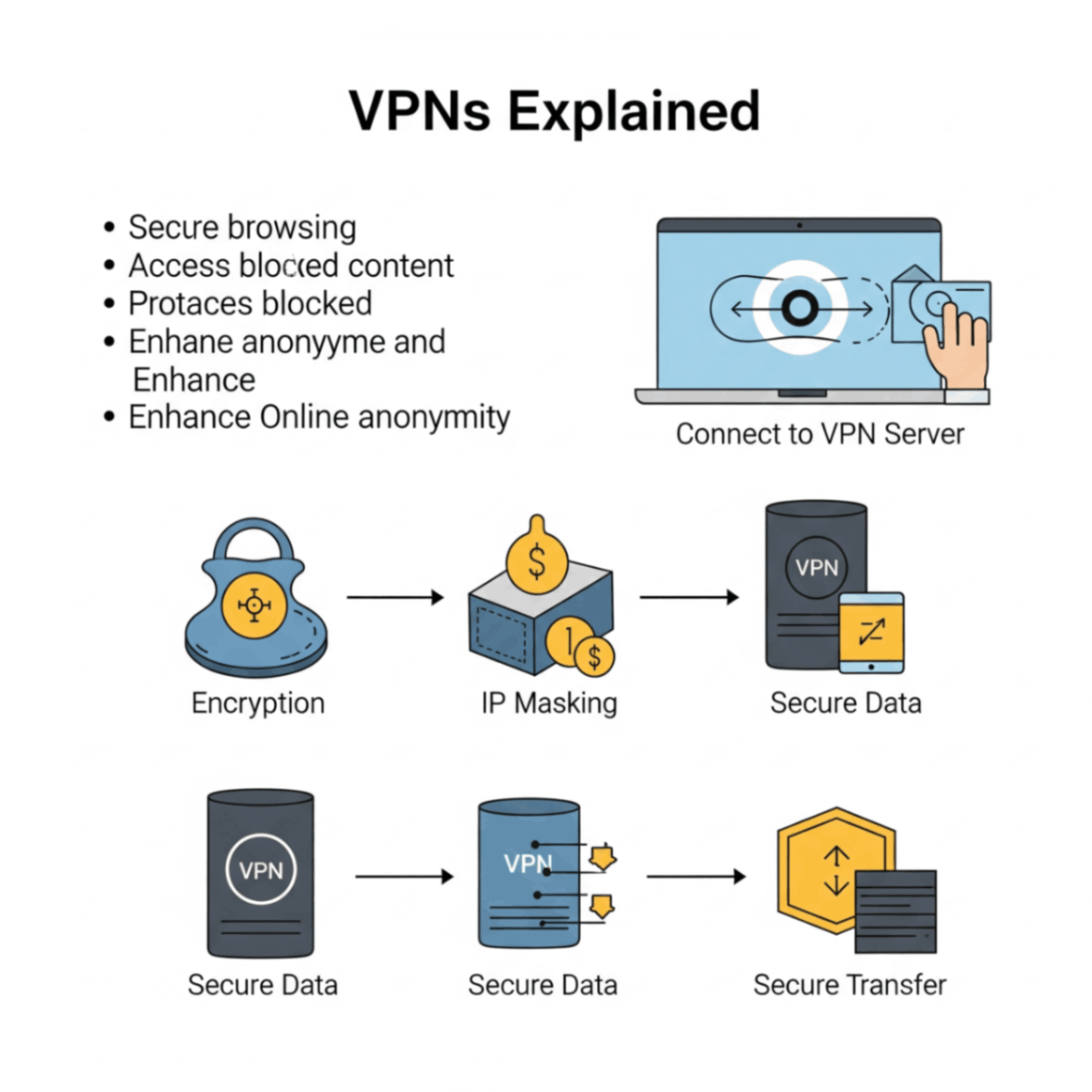
A VPN (Virtual Private Network) is software that creates an encrypted tunnel between your device and the internet. Instead of sending your traffic straight to websites, it goes first through a secure server operated by the VPN service. That process hides your IP address, encrypts your connection, and makes it harder for others to track what you’re doing online.

It’s not magic, but it does add a significant layer of security, especially when browsing on public or shared networks.

How Does a VPN Work?

Think of a VPN as a private lane on a motorway. Without one, your data travels along an open road where any hackers, internet providers, or advertising companies can see where you’re headed. With a VPN, you enter a tunnel: your traffic is encrypted, your IP address is masked, and your online path becomes far harder to trace.

Here’s the process in simple terms:

  1. You connect to a VPN app on your device.

  2. The VPN encrypts all the data leaving your device.

  3. Your data travels through the VPN provider’s secure server.

  4. From there, it exits to the internet, but your original IP address is hidden.

This setup keeps sensitive information—like banking logins, work emails, and personal browsing habits—private from prying eyes.

Why People Use VPNs in 2025

VPNs aren’t just for tech experts. Every day, internet users rely on them for a range of reasons. Some of the most common include:

  • Privacy from ISPs: Stops your internet provider from seeing everything you do.

  • Security on public Wi-Fi: Encrypts your data when using cafes, airports, or hotel Wi-Fi.

  • Remote work safety: Protects company data for employees working from home.

  • Streaming and geo-blocks: Let you access region-specific content while travelling.

  • Avoiding targeted advertising makes it harder for advertisers to build a detailed profile of you.


Table: Key Benefits of Using a VPN

Benefit Why It Matters
Encryption of data Prevents hackers from stealing sensitive info
IP address masking Makes online tracking more difficult
Safer use of public Wi-Fi Reduces risk when using unsecured networks
Bypassing geo-blocks Helps access content restricted by region
Remote work security Protects business communications and documents

Yes. In the UK, using a VPN is legal. However, how you use it matters. Activities that are illegal without a VPN, like cybercrime or piracy, remain illegal even with one. The UK’s National Cyber Security Centre recognises VPNs as a valid tool for personal and professional online security.

Limitations: What a VPN Won’t Do

A VPN is powerful, but it’s not a catch-all solution. It will not:

  • Stop phishing scams if you click on malicious links

  • Protects you from viruses or malware by itself

  • Make you anonymous to every government or organisation

Think of it as part of a broader security habit. Good passwords, two-factor authentication, and sensible browsing still matter.

VPNs for Businesses vs. Individuals

The way businesses use VPNs can be different from how individuals use them:

  • Individuals: Focus on privacy, streaming access, and Wi-Fi safety.

  • Businesses: Use enterprise VPNs to create secure connections between offices, remote workers, and company servers.

For small businesses, especially those handling client data, VPNs have become a basic requirement rather than an optional tool.

Trends in 2025: VPNs in Everyday Life

VPN technology has evolved in the last few years. Many providers now integrate features such as:

  • Split tunnelling (choosing which apps use the VPN)

  • Multi-device support

  • Built-in ad and tracker blocking

  • Compatibility with smartphones, tablets, and smart TVs

As cyber threats have increased, VPNs are being recommended by security professionals and even in public guidance from government agencies.

When You Should Consider Using a VPN

If any of the following sound familiar, a VPN could be worth adding to your digital toolkit:

  • You regularly work remotely or travel for work

  • You often use public Wi-Fi networks

  • You want to protect personal browsing from tracking

  • You stream content while travelling abroad

  • You store sensitive client information on cloud platforms

Trusted Sources and Further Reading

For official advice on protecting your data and online safety, check:

At Derektime.co.uk, we cover practical technology topics, from cybersecurity to digital innovation. You’ll also find guides on protecting data, managing online risks, and keeping up with new tech trends.

Conclusion: VPNs Explained and Why They Matter

The internet in 2025 is more complex than ever, and so are the threats. A VPN won’t solve every online risk, but it gives you a strong first layer of protection against data snooping and tracking.

VPNs explained simply: they encrypt your data, hide your IP address, and give you more control over your digital privacy. If you’re serious about security—whether for work, travel, or everyday browsing—it’s one of the smartest tools you can add to your online habits.

FAQ

1. Are VPNs safe to use?
Yes, when you choose a trusted provider with clear privacy policies. Free VPNs can be risky due to limited security and data collection practices.

2. Does a VPN slow down your internet?
It can slightly reduce speed because your data goes through an extra server. Premium VPNs minimise this effect.

3. Can a VPN hide me from all tracking?
It helps a lot, but does not make you invisible. Websites and apps can still track activity through cookies and logins.

4. Should I leave my VPN on all the time?
For the best protection, yes. Many VPN apps allow automatic connection on startup.

5. Is using a VPN over public Wi-Fi essential?
It’s strongly recommended. Public Wi-Fi is often unsecured, and a VPN helps protect your data.

Charting the Unknown: Why So Much of the Ocean Is Still Unexplored in 2025

0
how much of the ocean is unexplored

It’s 2025. We’ve got satellites tracking every street corner, we’re talking about missions to Mars and yet, if you look down instead of up, the truth is shocking: most of our planet’s ocean is still a blank map.

Scientists estimate that only about a fifth, maybe a quarter at best, of the seafloor has been mapped in detail. That means most of the deep sea? Still a complete mystery.

So why is that? Why, with all our gadgets and tech, is the ocean still one of the biggest unknowns on Earth? Let’s take a closer look, because the reasons aren’t as simple as you might think.

Why Have We Explored So Little?

It feels strange, doesn’t it? Space gets all the headlines, but here on Earth, more than 70% of the surface is covered in water that we barely understand.

Here’s the thing: the ocean is huge, it’s hard to get to, and it costs a fortune to explore. Unlike pointing a telescope into the sky, you can’t just look at the ocean floor. You have to physically go there, and that changes everything.

The Scale Problem

Imagine trying to cover 360 million square kilometres of deep, moving water. That’s the size of the ocean. On average, it’s 3.5 kilometres deep. Every time a research vessel goes out with sonar equipment, it’s like trying to paint a mural with a toothbrush, slow and painstaking. Even with fleets of ships, this is the kind of job that takes decades.

Tech Has Limits Underwater (And They’re Big Ones)

Why can’t we just use satellites?

Because light can’t travel through water the way it does through space. Satellites can only scan the surface. To map what’s underneath, we use sonar – sound waves bouncing off the seafloor – and that’s a much slower process.

And then there’s the pressure

The deeper you go, the worse it gets. At 10 km down (think Mariana Trench), the water pressure is more than 1,000 times what you feel on land. Most machines need special engineering just to survive down there.

Communication? Forget it.

Unlike space, where data beams back instantly, radio waves don’t travel well in water. So, when scientists send a submersible into the deep, it has to record everything on board. Only when it resurfaces do they see what it found. Real-time exploration? Pretty much impossible right now.

And Then There’s the Price Tag

If you think this sounds expensive, you’re right. These missions need research ships, remotely operated vehicles (ROVs), autonomous underwater vehicles (AUVs), sonar systems, scientists and months of planning. Each trip can cost millions.

The problem? Space exploration gets the spotlight and the money. Ocean science often has to fight for funding, so progress is slow.

What We Know in 2025

To put things into perspective, here’s where we stand today:

What We’ve Studied How Much We Know
Seafloor mapped in detail About 24%
Known marine species Less than 20%
Deep-sea mineral resources Barely studied
Hydrothermal vent sites found Only a few hundred

Here’s something people forget: the ocean is like Earth’s thermostat. It shapes the weather, soaks up carbon dioxide, and produces over half the oxygen we breathe. Without knowing what’s happening below the surface, we’re flying blind on climate change.

Organisations like the UK’s Met Office and gov.uk marine research programmes have been saying it for years: better deep-sea data means better climate predictions.

How Robotics and AI Are Slowly Changing the Game

The good news? Technology’s catching up.

We’ve now got autonomous underwater vehicles that can roam around on their own, packed with cameras and sensors. These robots don’t need constant human steering, which means they can explore for longer periods.

The data they bring back is massive, so massive that AI tools are now being used to analyse it. What used to take scientists years to study can now be done in months. Still, even with robots and AI, the ocean doesn’t give up its secrets easily.

The Big Push: International Collaboration

There’s a project called Seabed 2030, led by the Nippon Foundation and GEBCO, with one huge goal: to map the entire seafloor by 2030.

The UK, the US, Japan, and others are all chipping in. According to the BBC, these efforts have already mapped millions of square kilometres since 2020. But that’s just a fraction of what’s left.

Why Should You Care?

You might be thinking, OK, but how does this affect me?

A lot more than you’d think:

  • Weather forecasting: Better ocean data = more accurate predictions.

  • Resources: From deep-sea minerals to renewable energy.

  • Biodiversity: Protecting ecosystems we barely understand.

  • Medicine: Many drugs come from marine life.

In short, what we don’t know could change lives and economies.

What Could the Next 10 Years Look Like?

Here’s where things are headed:

  • By 2030, the goal is to have at least 50% of the seafloor mapped in detail.

  • A fleet of autonomous robots, going places ships can’t.

  • Submersibles are designed to survive crushing trench pressures.

  • Scientists across the world are sharing data in open platforms, instead of working in silos.

If these plans hold, we’ll finally start to close the knowledge gap.

Where to Read More

We cover stories like this – science, technology, climate change – at Derektime.co.uk. It’s where we look at how big ideas are shaping our world.

Wrapping It Up: Why the Ocean Is Still a Mystery

Here we are in 2025, with phones smarter than old supercomputers, yet most of the ocean is unmapped. Why? It’s huge, it’s expensive, and it’s just plain hard to reach.

But it’s not just curiosity. Understanding the ocean means understanding our future. If we’re serious about climate change, natural resources, and protecting life on this planet, charting the unknown and figuring out why so much of the ocean is still unexplored in 2025 isn’t optional – it’s essential.

Quick Action Steps

  • Push for more funding in marine science.

  • Back projects like Seabed 2030.

  • Support tech like autonomous underwater vehicles.

  • Talk about this – awareness changes priorities.

FAQ

1. How much of the ocean is mapped in 2025?
Only about 20–25% of the seafloor is mapped in detail.

2. Why is it harder to explore the ocean than space?
Because of crushing pressure, no light, and the difficulty of sending data through water.

3. What’s Seabed 2030?
It’s a global project trying to map the whole ocean floor by 2030.

4. Why does deep-sea research matter?
It helps predict weather, track climate change, find resources, and protect ecosystems.

5. How are robots helping?
Autonomous vehicles can go into dangerous, deep areas and gather data far faster than humans alone.

From Clicks to Clusters: How Google’s SGE Will Reshape SEO

0
Search Generative Experience SEO

Search engine optimisation (SEO) is entering a new era. Google’s Search Generative Experience (SGE) marks a significant shift from traditional keyword-driven rankings to AI-generated summaries and topic clusters. For businesses, marketers, and content creators in the UK, understanding how Google SGE changes the game is no longer optional—it’s essential.

In this guide, we’ll break down what SGE is, how it impacts your current SEO strategy, and what you need to do to future-proof your visibility. Whether you manage a corporate website, a content platform like Derektime, or a local service site, this change will impact how your content is discovered and consumed.

What is Google’s Search Generative Experience (SGE)?

SGE, or Search Generative Experience, is Google’s AI-powered search update designed to transform how information is presented. Instead of offering a list of links ranked by keyword and backlink weight, SGE delivers an AI-generated snapshot summarising key points in response to complex queries.

Key Features of SGE:

  • AI-generated summaries above traditional results

  • Contextual follow-up prompts and questions

  • Integrated multimedia answers (text, video, images)

  • Topic clustering to connect related queries

Unlike featured snippets, which pull directly from a single source, SGE synthesises information from multiple authoritative sources to provide a conversational overview. This changes how users interact with search and how websites appear in those results.

How SGE Works: From Questions to AI Clusters

SGE uses a large language model (LLM), similar to ChatGPT, to understand the user’s query in depth and respond with a condensed, cluster-based answer.

Here’s what that process looks like:

Stage What Happens
Input The user asks a complex or multi-layered question.
Parsing Google analyzes intent, context, and sub-topics.
Generation The AI generates a coherent summary pulling from top-ranking sources.
Clustering Related content is grouped into themes, providing next-step questions.
Display AI snapshot appears above regular search results with source links.

Key Differences Between Traditional Search and SGE

Understanding how SGE differs from the search engine results pages (SERPs) we’re used to is critical for adapting strategy.

Feature Traditional Search SGE
Focus Keyword matching Intent and context matching
User Action Click-based navigation In-SERP reading and exploration
Result Format Ranked list of links AI-generated summary with clustered links
CTR Dynamics High for position 1–3 Lower overall click-through for organic links
SEO Metric PageRank, backlinks, keywords Authority, relevance, topic coverage

Why This Shift Matters for SEO Professionals

SGE isn’t just another SERP tweak—it’s a fundamental restructuring of how Google serves and prioritises content.

What’s Changing:

  • Less direct traffic from traditional blue links

  • Higher competition to be included in AI summaries

  • Emphasis on topic authority, not just page optimisation

  • Engagement over ranking—answers must be informative, not just visible

For SEO professionals, this means rethinking how success is measured. Keyword rankings alone won’t tell the full story anymore.

You’ll need to monitor:

  • Inclusion in AI summaries

  • Cluster-wide content performance

  • User engagement metrics like dwell time and return visits

How SGE Impacts UK-Based Websites and SMEs

For UK businesses, the rise of SGE introduces both opportunities and new compliance risks. Especially if you’re serving location-specific audiences or operating under sector-specific regulation (like finance, health, or education).

Potential Effects:

  • Decreased visibility for SME websites that rely on narrow keyword targeting

  • Higher demand for trustworthy, E-E-A-T-friendly content

  • Preference for authoritative UK sources, such as:

If your site lacks transparent authorship, source citations, and depth of coverage, it’s less likely to be included in AI clusters. For content-driven sites like Derektime, this is a pivotal moment to upgrade editorial quality and topical breadth.

Actionable SEO Strategies for the SGE Era

Want to survive and thrive as SGE rolls out? These strategies will help future-proof your content.

1. Build Topical Authority

  • Cover full topic clusters (not just standalone blog posts)

  • Use content hubs, internal linking, and supporting articles

  • Focus on depth, context, and cross-topic connections

2. Prioritise E-E-A-T Signals

  • Include author bios with credentials

  • Reference trusted UK sources (e.g., gov.uk, bbc.co.uk)

  • Ensure transparency in publishing and updates

3. Optimise for AI Readability

  • Use clear headings and summaries

  • Answer questions directly using natural language

  • Keep sections skimmable, but informative

4. Improve Schema Markup

  • Add structured data for articles, FAQs, and reviews

  • Help Google identify your content type and relevance

5. Monitor Search Console + AI-SERP Inclusions

  • Watch for impression changes in informational queries

  • Identify content that appears in AI summaries or gets pushed below the fold

Opportunities and Risks: What to Watch

Like any major change, SGE offers both upside and downside depending on your readiness.

Opportunities:

  • Level playing field for newer, high-quality content creators

  • AI-driven traffic for long-tail, complex queries

  • Higher value on clarity, helpfulness, and content structure

Risks:

  • Decline in click-through rates (CTR) even with top ranking

  • Disappearance from above-the-fold positions

  • Increased dependence on Google’s AI interpretation of your content

By adjusting your strategy now, you avoid being left behind when the update becomes standard.

Tools to Optimise for SGE

Here’s a quick list of tools you can use to adapt and measure your performance in an SGE-driven search landscape:

Tool Purpose
Google Search Console Monitor impressions, queries, and CTR shifts
AnswerThePublic Discover cluster-related questions
Surfer SEO Optimise content for topical relevance
Ahrefs or SEMrush Track keyword and topic performance
Schema.org Markup Generator Add structured data to your pages

Final Thoughts: Preparing for the Future of Search

From clicks to clusters, Google’s SGE is changing what it means to rank on search engines. It’s no longer about chasing keyword positions—it’s about building meaningful, in-depth, and trustworthy content ecosystems.

If you’re running a UK-based website or SME, now is the time to double down on quality, structure, and transparency. Make sure your content is not just optimised, but genuinely helpful. Align with trusted sources. Build topical authority. And prepare to be discovered not just through clicks but through context.

FAQs

1. What exactly is Google SGE and when will it launch in the UK?

Google’s SGE is an AI-powered feature that generates summaries and answers directly in search results. It’s being tested in multiple regions and is expected to roll out more broadly in the UK within the next year.

2. Will SGE reduce organic traffic to my website?

Yes, in some cases. Because answers appear directly in the search results, users may not click through. However, high-value, authoritative content still has a chance to be featured—and clicked.

3. How do I know if my content appears in an AI summary?

Currently, tracking AI summary inclusions is limited. Watch for changes in impressions and CTR in Search Console and look for shifts in your top-performing queries.

4. Is keyword research still relevant in the age of SGE?

Absolutely. Keywords still indicate search intent. The difference is you’ll need to group them into clusters and build in-depth, connected content around those themes.

5. How can small UK websites stay competitive?

Focus on E-E-A-T, niche authority, and smart internal linking. Also, reference trusted sources like GOV.UK and prioritise reader-first content quality.

For more insights on navigating Google updates, digital strategy, and content marketing, visit Derektime UK.

Privacy-by-Design: Must-Know Data Rules for SMEs in the UK

0
UK data privacy 2025

Running a business in the UK? Then you’re handling data—whether you realise it or not. And with that comes responsibility. Today, customer trust and legal compliance go hand-in-hand, and that’s where Privacy-by-Design steps in.

So, what’s this all about? It’s not some legal buzzword or a checkbox to tick. Privacy-by-Design means thinking about privacy right from the beginning—when you’re building your website, setting up your CRM, or onboarding staff. For UK SMEs, it’s not just smart—it’s the law.

This guide breaks down everything you need to know: the rules, the risks, the benefits, and most importantly, how to make Privacy-by-Design part of how your business runs every day.

What Is Privacy-by-Design?

Imagine building a house. You wouldn’t wait until after it’s built to install locks on the doors, right? Privacy-by-Design is the same concept, just for data.

It’s about weaving privacy into your business from the start. Whether it’s your marketing tools, customer onboarding process, or HR system, they all need to think privacy-first.

The idea came from Dr. Ann Cavoukian, and now it’s a core part of the UK GDPR. So yes, it’s official. You’re expected to design systems and workflows that protect personal data by default, not just after a breach hits the news.

The Legal Backdrop: UK GDPR & the Data Protection Act 2018

Let’s talk legal—but we’ll keep it simple. Post-Brexit, the UK kept GDPR in place (it’s now called UK GDPR) and reinforced it with the Data Protection Act 2018. These laws apply to anyone handling personal data, and yes—that includes SMEs.

Here’s what you’re expected to do:

Legal Requirement What It Means
Privacy by Design Bake privacy into everything—from systems to workflows.
Lawful Processing Only use data when you’ve got a solid reason (like customer consent or legal duty).
Accountability Be able to prove you’re doing the right thing. Not just say it.
Records of Processing Keep track of what data you’re collecting and why.
Data Subject Rights People can ask to access, correct, delete, or restrict their data. You need to deliver.

Why SMEs Should Care

Still thinking this doesn’t apply to you? Let’s be real: data privacy isn’t just for tech giants and banks.

What happens if you ignore it?

  • Massive fines – Think £17.5 million or 4% of your turnover. Not small change.

  • Loss of trust – Once your customers stop trusting you with their data, they stop buying.

  • Blocked deals – Larger clients might cut ties if you’re not compliant.

  • Operational chaos – Investigations and data breaches can bring everything to a halt.

What happens if you get it right?

  • Customers feel safe and respected.

  • You stay on the right side of the law.

  • It’s easier to close partnerships and deals.

  • You build a brand that’s future-proof and trustworthy.

Privacy is no longer a bonus. It’s a brand asset.

The 7 Core Principles of Privacy-by-Design

Let’s break these down in plain English. These aren’t abstract ideas—they’re practical guidelines for how to run your business.

Principle What It Looks Like in Real Life
Proactive, not Reactive Don’t wait for a breach—plan.
Privacy by Default Data protection settings are turned ON, not off.
Built-in Privacy It’s part of your tech setup, not an afterthought.
Full Functionality You don’t sacrifice user experience for security—or vice versa.
End-to-End Security Data stays safe from collection to deletion.
Transparency People understand what you’re doing with their info.
User Respect Let people control their data easily and clearly.

This isn’t a full legal breakdown—but these are the absolute must-haves.

1. Don’t Collect What You Don’t Need

Just because you can collect data doesn’t mean you should. Keep it lean.

2. Have a Legit Reason

Consent, legal obligation, contract—whatever your reason, make sure it holds water.

3. Be Upfront About It

Use simple, plain language to explain what you’re collecting and why. No jargon. Just honesty.

4. Set a “Delete By” Date

Don’t keep data forever. Decide how long you actually need it, and set up a clear retention policy.

5. Consent Means Consent

No pre-ticked boxes. No silence as agreement. If you’re using consent, make sure it’s clear, informed, and easy to withdraw.

6. Third-Party Check

Using Mailchimp? Google Analytics? Any outside tools touching data? You need a contract and proof they’re compliant, too.

7. Have a Breach Plan

If something goes wrong, you’ve got 72 hours to tell the ICO. Know who’s doing what if disaster hits.


How to Implement Privacy-by-Design

Let’s get practical. Here’s how you start applying Privacy-by-Design without needing a legal team on speed dial.

Step 1: Map Your Data

Where’s your data coming from? Contact forms? Email signups? Know every point where data enters your system.

Step 2: Do a DPIA

A Data Protection Impact Assessment is like a risk forecast. If your data handling might impact people’s privacy in a big way, do one.
The ICO has a step-by-step guide.

Step 3: Fix Your Privacy Policy

Most SMEs have a dusty, unread policy buried in the footer. Rewrite it to reflect what you do. Be real. Be specific. Link to it clearly from your homepage, like we do at Derektime.

Step 4: Secure Everything

SSL, VPNs, passwords, 2FA—it all matters. Make it hard for hackers and internal errors to mess things up.

Step 5: Train Your Team

Your people are your first line of defence. Give them basic training on what data they can and can’t touch.

Step 6: Vet Your Vendors

Don’t just assume your software tools are compliant. Ask for their data protection policies. Get contracts in place.

Step 7: Automate the Boring Bits

Use tools to handle cookie consents, track opt-ins, and run policy updates. Check out:

Real-Life SME Examples

A Small E-commerce Store

  • Uses a cookie banner that respects No thanks.

  • Deletes cart abandonment emails after 30 days.

  • Keeps customer order data for accounting—but not forever.

A Local Recruitment Agency

  • Gets written consent from candidates before sharing CVs.

  • Wipes candidate records after six months of no contact.

  • They have a breach plan because they handle sensitive information daily.

 A SaaS Startup

  • Offers privacy settings right inside the dashboard.

  • Let users download or delete their oata.

  • Encrypts data in transit and at rest.


Handy Tools and Resources

Resource Why It’s Useful Link
ICO SME Hub Practical, jargon-free advice ico.org.uk
UK GDPR Full Text For legal reference legislation.gov.uk
NCSC SME Security Guide Security tips from the UK government ncsc.gov.uk
Derektime Blog Tips, trends, and compliance advice derektime.co.uk

Here’s the thing: Privacy-by-Design isn’t just a regulation box you check once and forget. It’s a mindset. A smart one.

By making privacy part of how you run your business, you avoid fines, build trust, and set yourself up for long-term success. And as rules evolve (and they will), you won’t be playing catch-up.

So map your data, update those dusty policies, train your team, and treat privacy like what it is: part of your brand, your promise, your edge.

FAQs (You’re Probably Wondering)

1. Do I need to follow GDPR if I’m a tiny business?

Absolutely. There’s no size limit in GDPR. If you process personal data (which you almost certainly do), the rules apply to you.

2. Is security the same as privacy?

Not quite. Security protects the data from bad actors. Privacy protects the person behind the data. You need both.

3. Can I just get consent for everything to stay safe?

Nope. Consent is only one lawful basis. It’s not a one-size-fits-all solution and misusing it can backfire.

4. What if someone asks to delete their data?

You’ve got to respond promptly—usually within a month. If you don’t have a deletion process in place, now’s the time to set one up.

5. How often should I review my privacy practices?

At least once a year—or whenever your systems, services, or data habits change.

Still have questions? Keep an eye on Derektime for more deep dives and hands-on compliance tips tailored for UK businesses just like yours.

Top Health-Tech Apps Changing Lives in 2025

0
best health tech apps 2025

Let’s be honest, health apps used to be all hype and no substance. A step counter here, a mood tracker there… but not much that made a difference in your real life.

Well, fast forward to 2025, and that’s all changed.

We’re now living in an era where health-tech apps are transforming lives. Whether it’s helping you manage diabetes, sleep better, stay on top of prescriptions, or even feel more in control of your mental health, there’s now an app for that, and it’s probably doing more for you than a few rushed GP visits ever could.

So, if you’re tired of navigating the NHS backlog or just want more control over your health without the guesswork, this guide’s for you. These are the health-tech apps that are making a real difference in 2025 and they’re doing it with science, trust, and a bit of smart design.

Why Health-Tech Isn’t Just a Trend Anymore

Let’s set the scene: the NHS is stretched thin, GP appointments are harder to get, and you don’t always want to “wait and see” when something feels off.

That’s where health-tech steps in—not to replace doctors, but to give you tools that help in between appointments, reduce unnecessary trips, and just make you feel more in control.

Here’s what’s changed the game in 2025:

  • You can now track and manage chronic conditions without piles of paperwork

  • AI-backed symptom checkers are catching issues before they get worse

  • Mental health support is finally accessible 24/7—without long waiting lists

  • You can view, manage, and interact with your NHS care on your phone

And the best part? Most of these tools are either NHS-backed, NICE-approved, or developed by real clinicians who understand what people need.

1. MySugr – For When Diabetes Is Part of Life

Managing diabetes isn’t easy. But MySugr makes it feel… well, manageable.

You can track your blood sugar, log what you eat, and keep tabs on your insulin levels in one place. And the best part? It syncs with your devices, so you’re not stuck manually logging everything.

Why people love it:

  • No more guesswork around food and blood sugar

  • It estimates your HbA1c so you can see long-term trends

  • You get coaching tailored to your needs

This isn’t just a digital notebook; it’s a pocket-sized diabetes companion.

2. Sleepio – Because Counting Sheep Doesn’t Work

If you’ve ever tossed and turned at 3 AM, wondering why your brain won’t shut off, you’re not alone. And that’s exactly what Sleepio tackles.

Developed by psychologists and approved by NICE, Sleepio uses digital CBT (Cognitive Behavioural Therapy) to help you improve sleep—not just mask the problem.

Why it matters:

  • Personalised sleep plans based on how you think and feel

  • Reduces the need for sleeping pills

  • Offered by the NHS in many areas

It’s like having a sleep therapist in your pocket—without the waitlist.

🡪 Official Sleepio guidance from NICE

3. LloydsDirect (formerly Echo) – Prescription Life, Simplified

Ever forget to reorder your meds? Or hate standing in line at the pharmacy? LloydsDirect makes that a non-issue.

You connect your NHS prescription, and the app reminds you when it’s time to reorder. Then it delivers it to your door for free.

Perks that help:

  • Real-time updates on your prescription status

  • Refill reminders (because we all forget sometimes)

  • NHS login makes setup easy

It’s simple, smart, and surprisingly stress-reducing—especially if you’re juggling multiple medications.

4. Peppy – Finally, Real Help for Life’s Milestones

Menopause, fertility, new parenthood don’t come with user manuals. That’s where Peppy shines.

It gives you access to real health professionals (yep, humans) who can guide you through major life transitions. Whether it’s hormone changes or baby sleep schedules, Peppy covers the stuff most health systems overlook.

Why it’s different:

  • Specialist-led support for topics that usually get ignored

  • Chat-based and private

  • Used by NHS staff and top UK employers

It’s like having a health coach for life’s messy in-between moments.

5. The NHS App – Not Just a COVID Tool Anymore

If you’re not using the NHS App by now, you’re missing out. It’s become the go-to hub for accessing your health info, prescriptions, and appointments—all in one place.

And in 2025, it’s faster, smarter, and way more user-friendly than it used to be.

What you can do:

  • Book GP appointments

  • View your test results and health records

  • Order repeat prescriptions

  • Access NHS 111 without calling

You’re holding your medical history in your hand. Safe, secure, and under your control.

🡪 Learn more at NHS.gov.uk

6. Wysa – Mental Health Support That Gets You

Mental health care shouldn’t be hard to reach—and Wysa makes sure it isn’t.

You get 24/7 access to an AI-based emotional support chatbot, plus tools like CBT, journaling, and mindfulness. No need to schedule. No waiting list.

Why people trust it:

  • Anonymous and private

  • Backed by NHS digital pilots

  • You can also access human coaches if you upgrade

Perfect for those 2 AM What’s wrong with me? moments when you need clarity, not clichés.

7. Healthily – Your Trusted Symptom Checker

Let’s be honest—we’ve all Googled symptoms and freaked ourselves out. Healthily fixes that.

It gives you accurate, NHS-aligned health info and triage advice—without the doom spiral. If it says you should go to A&E, you probably should. If not, you can rest easy.

Why it works:

  • Built by doctors, not data scrapers

  • Offers personalised self-care plans

  • GDPR compliant and UK-based

It’s your should I call the GP? Filter.

8. Oviva – Nutrition That’s Personal (and Works)

Managing your weight or diet due to a health condition? Oviva connects you with NHS-backed dietitian coaching via app, so you can make real, sustainable changes—without fad diets or calorie obsession.

How it helps:

  • Remote coaching with real professionals

  • Custom food, goal, and mood tracking

  • Trusted by the NHS in multiple regions

It’s not a weight-loss app. It’s a health empowerment tool that works with your body, not against it.

Comparison Table: Life-Changing Health-Tech Apps in 2025

App Name What It Does Best For NHS Connected?
MySugr Diabetes tracking + coaching People with Type 1/2 diabetes Yes (some)
Sleepio Digital CBT for insomnia Anyone with sleep issues Yes
LloydsDirect Manage and deliver prescriptions People on regular medication Yes
Peppy Menopause, fertility, men’s health Life transitions + work support Yes (employers)
NHS App Centralised digital health access Everyone Yes
Wysa AI + CBT for mental health Anxiety, stress, low mood Yes (pilots)
Healthily Symptom checker + self-care plans Everyday health questions Yes
Oviva Nutrition and dietitian coaching Obesity, diabetes, recovery Yes

Wysa & Student Anxiety
A university student used Wysa nightly during exam season and reported fewer panic attacks and better sleep—without needing medication.

Sleepio & Insomnia Recovery
One NHS patient said they finally came off sleeping pills after completing the Sleepio programme—and now sleep through the night.

LloydsDirect & Accessibility
An elderly patient with mobility issues now receives her prescriptions on time, without needing to rely on family or carers.

What You Can Do Next (No Guessing Required)

  • Download the NHS App, it’s the easiest first step.

  • Explore apps like Healthily or Wysa for low-pressure support.

  • Talk to your GP about accessing tools like Sleepio or Oviva if eligible.

  • Check with your employer; many now offer Peppy or Wysa as part of wellness perks.

  • Bookmark our Health-Tech section for updates and deeper guides.

FAQs: What People Are Asking About Health-Tech in 2025

1. Can health-tech apps replace a doctor?
No, and they’re not meant to. They support your health between appointments and help you stay on track—but when in doubt, call your GP.

2. Are these apps private and secure?
Yes. All apps listed follow GDPR rules, and many are approved or integrated with NHS services.

3. Do I need an NHS referral to use these?
Some (like Oviva or Sleepio) might require a referral depending on your area. Others, like Wysa or Healthily, are open to everyone.

4. What if I live in Scotland or Wales?
Many of these apps are UK-wide, but NHS integration may vary. Always check availability in your region.

5. How do I know if an app is trustworthy?
Stick with NHS-backed tools or those recommended by trusted health sources. For more, visit NHS Digital.

Final Thoughts: Health-Tech That’s Helping

Forget the gimmicks. The health-tech apps changing lives in 2025 are the real deal. They’re giving people control, insight, and confidence to handle their health without waiting weeks for appointments or guessing what’s wrong.

They’re not a replacement for doctors. But they’re the next best thing between visits. And for many people? They’re already making life easier, healthier, and more manageable.

Top Free Tools for Remote UK Workers in 2025

0
free remote software 2025

Let’s face it, remote work isn’t going anywhere. Whether you’re tucked away in a quiet corner of Yorkshire or squeezing in Zoom calls from a flat in London, working remotely in the UK has become the new normal. But here’s the thing: without the right tools, remote life can get messy fast.

If you’ve ever juggled tabs, scrambled for passwords, or stared at a laggy video call wondering what went wrong, you know exactly what I mean. That’s why I put together this list of top free software tools every UK remote worker needs in 2025. These aren’t gimmicks. These are genuinely useful, reliable tools that make remote life smoother, smarter and let’s be honest, a lot less stressful.

So, Why Do These Tools Even Matter?

Because remote work sounds great until… it isn’t. Productivity slips, files get lost, Zoom fatigue creeps in, and suddenly you’re more burned out than you were in the office.

The truth? The tools you use can make or break your day. And not every “free” tool is worth your time. This guide focuses on:

  • Tools that work

  • Tools that are safe, secure and GDPR-compliant

  • And well-respected ones  in the UK and beyond

No fluff. Just free tools that punch above their weight.

1. Productivity & Task Management That Doesn’t Suck

Trello – Because Sticky Notes Don’t Cut It Anymore

If you like seeing everything in one place (and who doesn’t?), Trello’s visual boards are gold.

What makes it awesome?

  • Drag-and-drop tasks like you’re rearranging your fridge magnets

  • Add checklists, deadlines, and attachments

  • Share boards with your team — or just keep them to yourself

Think of it as your digital whiteboard, minus the squeaky markers.

Notion – A Nerdy Dream for Organisers

Notion’s the kind of tool that grows on you. At first, it’s a bit like, “Wait… what do I do with this?” But give it a week? You’ll be hooked.

Why it’s brilliant:

  • All-in-one: notes, docs, to-do lists, calendars

  • Create your dashboard (yes, really)

  • Use it solo or share with a small team  free for personal use

Pro tip: Set it up once, and it’ll save you hours every week.

Clockify – Time Tracking Without the Pain

Trying to bill clients fairly? Or just keep tabs on how long tasks take? Clockify’s your new time cop.

What you get:

  • Track hours by project or client

  • Export reports (perfect for invoicing)

  • Works on web, desktop, or phone

It’s like a punch clock but way cooler and way more forgiving.

👉 Try Clockify

2. Communication Tools That Don’t Drive You Crazy

Microsoft Teams (Free Version) – The Underrated Hero

If you’ve used Teams before and rolled your eyes, give it another shot. The free version in 2025 is surprisingly good.

Why bother?

  • Solid video calls

  • File sharing that syncs

  • Chat channels for different teams

And since it’s backed by Microsoft, you can trust the security.

Slack – Still the Cool Kid for Team Chat

Slack’s like a modern-day IRC (if you remember that, you’re officially old). But it’s sleek, fun, and gets the job done.

Free plan perks:

  • 90-day message history (plenty for most teams)

  • 10 app integrations (hello, Trello!)

  • Huddles for quick calls

Just don’t fall into the trap of chatting all day and forgetting to work.

Zoom (Free) – Because We’re Still Doing This

Yes, it still has that 40-minute cap for group calls, but Zoom’s free plan is more than enough for most meetings.

Best bits:

  • Super clean video quality

  • Screen sharing with zero fuss

  • Virtual backgrounds for when your flat’s a mess

Just be sure to check your camera angle. No one wants to stare up your nose.

3. Cybersecurity Tools to Keep You Safe (Without Costing a Penny)

Proton Mail – Email That Minds Its Own Business

If you’re sharing sensitive stuff, regular Gmail just won’t cut it. Proton Mail keeps your emails locked up tight.

What it does:

  • End-to-end encryption

  • Based in Switzerland (yes, that still matters)

  • Sleek, simple interface

The free tier gives you 1GB of storage, plenty unless you’re sending cat videos daily.

Bitwarden – Because “123456” Is Not a Password

Still using the same password everywhere? Bitwarden fixes that without nagging.

Why it’s a no-brainer:

  • Stores unlimited passwords

  • Works on all your devices

  • Auto-fills login forms

It’s open-source, trusted by security pros, and yep — 100% free.

👉 Officially recommended by the UK’s NCSC

Malwarebytes – Your Backup Bodyguard

Windows Defender’s decent these days, but if something slips through? Malwarebytes catches it.

What it does:

  • On-demand malware scans

  • Cleans up junk

  • Won’t slow your system down

Just use the free version for scans no need to pay unless you want real-time protection.

4. File Handling and Docs, Made Simple

Google Drive – Because We’re All Using It Anyway

Whether you love or hate Google, Drive is still unbeatable for easy file sharing and collaboration.

At a glance:

Feature Google Drive (Free)
Storage 15 GB
File Sharing Yes, with permissions
Collaboration Docs, Sheets, Slides
Accessibility Web + Mobile

Works perfectly for solo workers or micro-teams.

LibreOffice – If You’re Overpaying for Word

Don’t want to shell out for Microsoft Office? LibreOffice does almost everything you need — without the cost.

Includes:

  • Writer (Word-style)

  • Calc (Excel-style)

  • Impress (PowerPoint-style)

And yes, it opens and saves MS Office formats, so you’re covered.

5. Creative Tools for Content and Presentations

Canva – For When You’re Not a Designer

Even if design isn’t your thing, Canva makes it feel like it is.

What you can whip up:

  • Presentations

  • Instagram posts

  • Reports and CVs

The free plan is generous. Great for personal branding, small businesses, or remote marketing gigs.

OBS Studio – Screen Recording Without Limits

Need to record a tutorial? Run a webinar? OBS has your back.

Why you’ll love it:

  • High-quality screen capture

  • Live-streaming options

  • Scene-switching for pros

No watermarks, no recording limits. Just clean, reliable recording.

6. Wellness & Work-Life Balance Tools (Because Burnout Is Real)

Headspace – Free If You Work for the NHS (Sometimes More)

Mindfulness isn’t woo-woo anymore — it’s science. Headspace helps clear your head so you can work better.

Why try it:

  • Guided meditations

  • Focus-enhancing background music

  • Sleep support (because stress = insomnia)

Sometimes offered free to UK workers through employers or the HS access.

Stretchly – Little Breaks That Make a Big Difference

This tiny app reminds you to get up, stretch, blink, and just breathe.

Why it matters:

  • Prevents RSI

  • Improves focus

  • Keeps you from turning into a desk potato

Simple idea. Big impact.

Quick Recap: Must-Have Free Tools for UK Remote Workers

Category Tool Why It’s Worth It
Task Management Trello Visual and super intuitive
Notes/Wikis Notion Custom dashboards and docs in one place
Time Tracking Clockify Track hours like a boss
Team Chat Slack Channels, huddles, integrations
Video Calls Zoom Still, the easiest for clean video
Secure Email Proton Mail Encryption without effort
Passwords Bitwarden Passwords made safe and simple
Storage Google Drive 15GB free and ready to go
Office Suite LibreOffice Full-featured without the fee
Design Canva Instant designs with zero skills needed
Recording OBS Studio Pro-level screen recording
Wellness Stretchly Stay healthy while working hard

Let’s keep it real: remote work isn’t always a breeze. But the right free tools can take a ton of pressure off your plate. Whether you’re writing, designing, planning, or just trying to stay sane, these software picks will have your back.

So, if you’re looking for the top free software tools every UK remote worker needs in 2025, start here. Test a few. See what fits. And don’t forget to tweak your setup as your work evolves.

FAQs: What UK Remote Workers Are Asking

1. Are these tools GDPR-compliant?
Most of them are, especially the ones like Proton Mail and Bitwarden that prioritise privacy. Always check individual policies just to be safe.

2. Can I run a business with just free tools?
You’d be surprised. Tons of freelancers and micro-startups do exactly that. Paid features are nice—but not always necessary.

3. Are these tools secure enough for sensitive work?
Yes, if you follow best practices (2FA, password managers, encryption). Bitwarden and Proton Mail, in particular, are built for security.

4. Where can I learn more about UK remote work policies?
Start with these:

5. Got more remote work tips?
Absolutely. Dive into our Remote Work Hub for more tips, tricks, and real-world insights.

How to Build a Profitable Digital Marketing Funnel

0
profitable marketing funnel UK

Introduction

Understanding how to build a profitable digital marketing funnel is crucial for any business aiming to increase online conversions and sales. A well-structured funnel guides potential customers through each stage of the buying journey, from awareness to purchase, while maximising profitability. In 2025, businesses of all sizes can benefit from a strategic approach to digital funnels, leveraging content marketing, email automation, and paid ads to optimise every stage of the customer journey. This guide provides practical, actionable steps for building an effective and profitable digital marketing funnel.

What is a Digital Marketing Funnel?

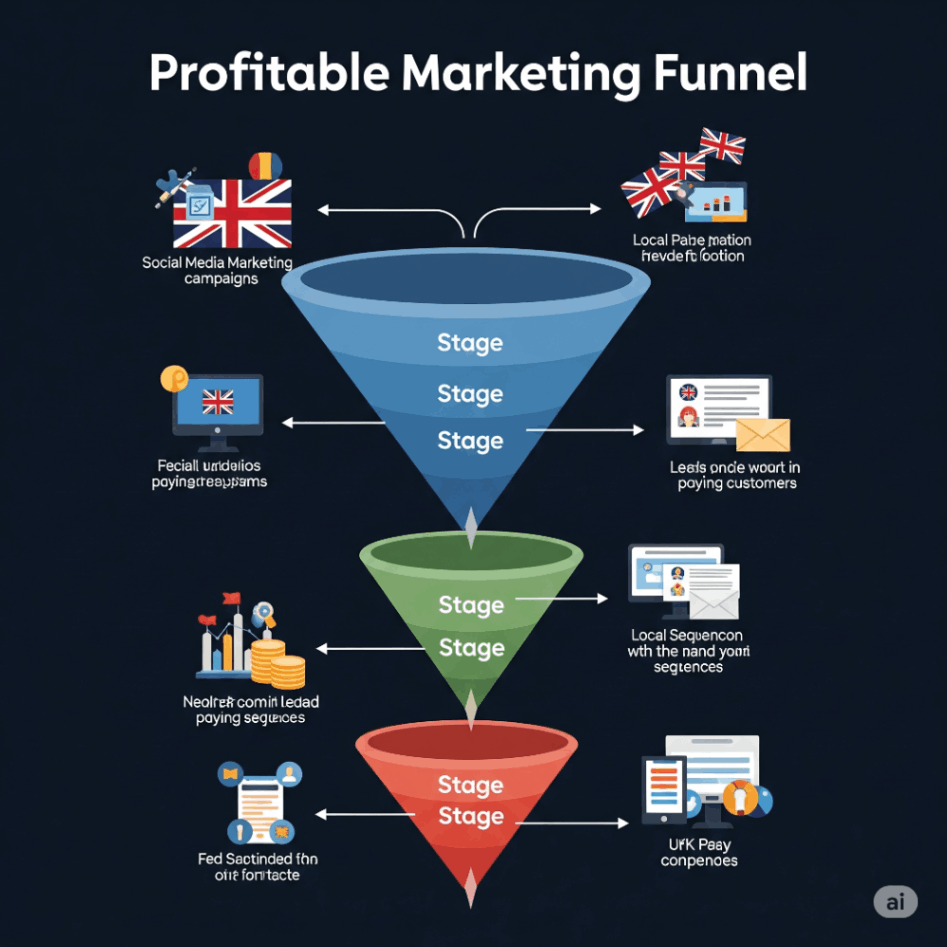
A digital marketing funnel represents the journey a potential customer takes from first discovering your business to becoming a paying customer. It consists of several stages, each with specific objectives and strategies.

Typical Funnel Stages:

  • Awareness: Capturing the attention of potential customers.

  • Interest: Engaging visitors with valuable information.

  • Consideration: Nurturing leads through targeted content and offers.

  • Conversion: Turning leads into paying customers.

  • Retention: Encouraging repeat purchases and brand loyalty.

Why Digital Marketing Funnels Matter

A profitable digital marketing funnel delivers multiple benefits:

  • Increased Conversions: Converts more visitors into customers.

  • Higher Revenue: Maximises lifetime value through upsells and repeat sales.

  • Improved Customer Experience: Offers personalised, relevant touchpoints.

  • Reduced Acquisition Costs: Makes marketing spend more efficient.

  • Scalability: Builds a repeatable system for consistent growth.

Step 1: Define Your Funnel Goals and Target Audience

Before building your funnel, establish clear objectives and understand your target market.

Funnel Goal Examples:

  • Generate 500 qualified leads per month

  • Achieve a 5% conversion rate from lead to customer

  • Increase average order value by 15% through upsells

  • Improve customer lifetime value by 20%

Identify Your Target Audience:

  • Demographics: Age, location, gender

  • Interests: Hobbies, preferences

  • Pain Points: Challenges your product/service solves

  • Buying Behaviour: Online activity, purchasing habits

Step 2: Create High-Quality Awareness Content

At the top of the funnel (TOFU), your goal is to attract and engage a broad audience.

Effective TOFU Strategies:

  • SEO-Optimised Blog Posts: Drive organic traffic (BBC Business).

  • Social Media Content: Short videos, reels, infographics.

  • Lead Magnets: Free resources like e-books, templates, or guides.

  • Paid Ads: Google Ads, Facebook Ads targeting cold audiences.

Awareness Strategy Purpose Example Content
Blog Articles Drive search traffic “Top 10 Strategies to Boost E-commerce Sales”
YouTube Videos Build brand awareness Product demos, industry tips
Social Media Posts Engage audiences on platforms LinkedIn posts, Instagram reels
Webinars Educate and nurture leads Free online training sessions

Step 3: Build Lead Capture Mechanisms

Converting awareness into interest involves capturing visitor information to nurture them further.

Key Lead Capture Tools:

  • Landing Pages: Dedicated pages with clear calls-to-action (CTAs).

  • Opt-In Forms: Embedded on blog posts or pop-ups.

  • Quizzes/Surveys: Interactive methods to segment leads.

  • Email Signup Incentives: Discounts, downloadable resources.

Best Practices:

  • Use simple, distraction-free landing pages.

  • Offer valuable lead magnets relevant to your product.

  • Optimise opt-in forms for mobile devices.

Step 4: Nurture Leads with Email Marketing

Middle of the funnel (MOFU) strategies focus on building relationships with your leads.

Email Marketing Tactics:

  • Welcome Series: Introduce your brand and key products.

  • Educational Content: Provide tips, how-to guides, and product usage information.

  • Personalised Product Recommendations: Based on user behaviour.

  • Exclusive Offers: Encourage small conversions (e.g., first-time purchase discounts).

Email Campaign Type Goal Example Subject Line
Welcome Email Establish brand connection “Welcome! Here’s 10% off your first order.”
Educational Series Build trust and interest “How to solve [pain point] quickly”
Product Recommendation Email Drive sales with relevance “Recommended just for you”
Limited-Time Offer Create urgency for conversion “48 Hours Only: Save 25% on Your Favourite”

Step 5: Convert Leads into Paying Customers

Bottom of the funnel (BOFU) strategies help close the sale.

High-Converting BOFU Tactics:

  • Retargeting Ads: Serve targeted ads to website visitors or email subscribers.

  • Product Demos/Consultations: Offer free trials, product demos, or consultations.

  • Customer Testimonials/Case Studies: Build trust with social proof.

  • Discounts and Incentives: Limited-time offers to drive urgency.

BOFU Strategy Conversion Goal
Retargeting Campaigns Re-engage site visitors
Case Studies Build credibility and trust
Product Demos Remove objections and increase conversions
Limited-Time Discounts Create urgency to buy

Step 6: Increase Profitability Through Upsells and Cross-Sells

Maximise profitability after conversion through:

  • Upsells: Offer premium versions or add-ons post-purchase.

  • Cross-Sells: Recommend complementary products.

  • Bundle Offers: Group products/services for higher order value.

  • Loyalty Programs: Reward repeat customers with points or discounts.

Examples of Profitable Upsell Techniques:

Upsell Technique Example
Product Upgrade “Upgrade to premium for only £10 more”
Complementary Add-on “Add a protection plan to your device.”
Bundle Offer “Buy 2, get 1 free”
Loyalty Reward “Earn 200 points with this purchase.”

Step 7: Retain Customers with Post-Sale Engagement

The funnel does not end after purchase. Focus on retention and repeat sales.

Post-Sale Strategies:

  • Follow-up Emails: Thank-you messages, product care tips.

  • Replenishment Reminders: Remind customers when it’s time to restock.

  • Feedback Requests: Collect reviews and testimonials.

  • VIP Offers: Early access to new products or exclusive deals.

Step 8: Optimise and Automate Your Funnel

Tools to Automate Funnel Management:

  • Email Automation: Mailchimp, ConvertKit, Klaviyo.

  • CRM Automation: HubSpot, Salesforce, Zoho CRM.

  • Sales Funnels: ClickFunnels, Leadpages.

  • Analytics Tools: Google Analytics, Hotjar for funnel tracking.

Optimisation Tips:

  • Split test landing pages and email subject lines.

  • Use analytics to identify bottlenecks.

  • Regularly update content to remain relevant.

  • Review customer feedback for continuous improvement.

Conclusion

Mastering how to build a profitable digital marketing funnel enables businesses to attract, convert, and retain customers more effectively. By strategically guiding prospects through each stage — from awareness to retention — you create a sustainable model for revenue growth. Use targeted content, efficient automation tools, and consistent optimisation to ensure long-term profitability from your digital marketing efforts.

FAQ: How to Build a Profitable Digital Marketing Funnel

1. What is the most important part of a digital marketing funnel?

Every stage is essential, but converting leads to customers (BOFU) has the most direct impact on revenue.

2. How long does it take to build an effective funnel?

Setting up a basic funnel can take a few weeks. Optimising it for profitability typically takes 2-3 months of testing and refinement.

3. Can small businesses afford to build a digital marketing funnel?

Yes, many affordable tools (like Mailchimp, ConvertKit) are available for small businesses to build effective funnels on a budget.

4. Should I hire an agency or build my funnel in-house?

It depends on your resources. Agencies offer speed and expertise, while in-house teams offer better control and long-term savings.

5. How do I measure the success of my funnel?

Track key metrics like conversion rates, customer acquisition cost (CAC), average order value (AOV), and customer lifetime value (CLV).

For more marketing strategies, growth tips, and practical business resources, visit DerekTime and explore our expert guides tailored for UK businesses.

How to Automate Your Business Operations Using AI

0
business automation AI UK

Introduction

Knowing how to automate your business operations using AI can transform your company’s efficiency, reduce costs, and improve customer satisfaction. As artificial intelligence becomes more accessible in 2025, businesses of all sizes can leverage AI tools to automate repetitive tasks, streamline workflows, and gain a competitive advantage. This guide explains the benefits, tools, and step-by-step methods to successfully implement AI automation across key business functions.

Why Automate Business Operations with AI?

AI-driven automation offers several key benefits for modern businesses:

  • Cost Savings: Reduces reliance on manual labour and external contractors.

  • Time Efficiency: Completes repetitive tasks faster than human employees.

  • Improved Accuracy: Minimises errors in data entry, accounting, and administrative tasks.

  • Better Customer Experience: Enables 24/7 service through AI chatbots and smart assistants.

  • Scalability: Allows businesses to grow without proportional increases in overhead.

Key Areas Where AI Can Automate Your Business

Business Function AI Automation Tools & Benefits
Customer Service Chatbots, virtual assistants providing 24/7 support
Marketing AI-driven email campaigns, social media scheduling, and content creation
Sales Predictive analytics, AI-based CRM tools
Human Resources AI recruitment platforms, automated onboarding
Accounting Automated invoicing, expense tracking, and financial forecasting
Inventory Management Demand forecasting, smart reordering systems
Cybersecurity AI threat detection, real-time monitoring
Data Analysis AI-powered dashboards, real-time reporting

Step 1: Identify Repetitive Tasks Suitable for Automation

Begin by auditing your business processes and pinpointing tasks that are:

  • Time-consuming

  • Repetitive in nature

  • Prone to human error

  • Not requiring complex decision-making

Examples of Automatable Tasks:

  • Email responses

  • Appointment scheduling

  • Invoice generation

  • Inventory restocking alerts

  • Basic customer service queries

Step 2: Choose the Right AI Tools for Your Business

There are several affordable and accessible AI tools available for UK businesses:

Popular AI Tools by Function:

Business Function Recommended AI Tools
Customer Support ChatGPT, Tidio, Drift, Intercom
Marketing Mailchimp AI, HubSpot AI, Jasper, Copy.ai
Sales Salesforce AI (Einstein), Pipedrive AI, Zoho CRM AI
HR & Recruitment Zoho Recruit AI, HireVue, Pymetrics
Accounting Xero AI, QuickBooks Smart Insights, Sage Accounting AI
Project Management Asana AI, Trello with Butler Automation, ClickUp AI

Integration Tips:

  • Choose AI tools that integrate easily with your current systems.

  • Prefer platforms with strong UK user support and GDPR compliance.

Step 3: Set Clear Automation Goals

Define Your Objectives:

  • Reduce operational costs by a target percentage

  • Increase response speed to customer queries

  • Lower error rates in financial reporting

  • Free up team time for strategic work

Setting SMART goals (Specific, Measurable, Achievable, Relevant, Time-bound) helps evaluate automation success.

Step 4: Train Employees on AI Tools

Successful automation requires staff to understand and effectively use new tools.

How to Train Your Team:

  • Conduct in-house workshops

  • Use vendor-provided training resources

  • Offer online AI literacy courses

  • Create standard operating procedures (SOPs) for AI tool usage

This reduces resistance and ensures a smoother transition.

Step 5: Monitor and Optimise AI Performance

After implementation, regularly monitor the AI system’s performance.

Key Performance Indicators (KPIs) to Track:

  • Task completion time reduction

  • Customer satisfaction ratings

  • Cost savings achieved

  • Error rate improvements

  • Increase in sales conversion rates

Optimise your AI setup by:

  • Regularly updating AI models

  • Reviewing performance dashboards

  • Gathering employee feedback

  • Adjusting automation rules as your business evolves

Common Mistakes to Avoid in AI Automation

Mistake Impact on Business Operations
Automating Complex Decision-Making AI may struggle with nuanced, human-centric decisions
Ignoring Staff Training Leads to misuse of AI tools and operational bottlenecks
Lack of Monitoring AI performance deteriorates without regular oversight.
Over-Automating Customer Interaction Risk of losing personal touch with customers
Choosing Wrong AI Tools Poor integration can lead to inefficiencies and wasted costs

Example of AI Automation Roadmap for Small UK Business

Phase Action Items
Phase 1 Audit tasks, identify automation opportunities
Phase 2 Choose and implement AI tools for customer service and marketing
Phase 3 Automate accounting and inventory management processes
Phase 4 Introduce AI in sales and HR functions
Phase 5 Regular reviews and optimisation of AI systems

Advantages and Disadvantages of AI Automation

Advantages Disadvantages
Operational cost reduction Initial setup and training costs
Improved efficiency and scalability May not suit highly creative tasks
Consistent service delivery Risk of overdependence on technology
Access to advanced data insights Requires continuous monitoring and updates
Faster business growth potential GDPR and data privacy compliance are required

AI Automation and Data Privacy Regulations in the UK

Key Regulations to Know:

  • GDPR Compliance: AI tools must adhere to the General Data Protection Regulation (GDPR).

  • AI Ethics Guidelines: Consider ethical AI principles such as transparency and fairness.

  • Data Security: Use platforms with robust security features to protect sensitive data.

Staying compliant avoids legal risks and enhances customer trust.

Step-by-Step Summary: Automate Your Business with AI

Step Action Summary
1 Identify repetitive business tasks to automate
2 Choose AI tools suited to your operational needs
3 Set clear, measurable automation goals
4 Train your team to integrate AI into daily operations
5 Monitor KPIs and optimise AI tools regularly

Conclusion

Knowing how to automate your business operations using AI equips UK companies with powerful tools to streamline processes, cut costs, and enhance productivity. By selecting the right AI applications, training your staff, and regularly optimising your systems, you can achieve sustainable business growth while maintaining quality and compliance. Embrace AI as a strategic partner in building an efficient, future-ready business model.

FAQ: How to Automate Your Business Operations Using AI

1. Is AI automation suitable for all types of businesses?

Most businesses can benefit from AI in areas like customer service, marketing, and accounting, though highly creative sectors may require human oversight.

2. What is the cost of AI tools for small businesses in the UK?

Many AI tools offer affordable entry points, with pricing starting from £10-£50 per month, scaling up based on features and usage.

3. Do I need technical expertise to implement AI in my business?

No, many AI tools are designed for non-technical users with intuitive dashboards and customer support.

4. How quickly can I see results from AI automation?

Many businesses report noticeable efficiency improvements within a few weeks of AI implementation. Full ROI may take several months.

5. Is AI automation compliant with UK data protection laws?

Yes, by choosing GDPR-compliant tools and following best practices, your AI setup can fully align with UK legal requirements.

For more expert guides on AI, business automation, and growth strategies, visit DerekTime and access practical resources tailored for UK businesses.

How to Build a Low-Risk Stock Portfolio in the UK

0
low risk stock portfolio UK

Introduction

Understanding how to build a low-risk stock portfolio in the UK is essential for investors seeking stable returns with minimal exposure to market volatility. Whether you are new to investing or approaching retirement, a low-risk strategy helps preserve capital while achieving steady growth. This guide provides step-by-step insights on selecting defensive stocks, diversifying assets, and balancing risk across sectors to create a portfolio suited for long-term financial security.

Why Choose a Low-Risk Stock Portfolio?

Low-risk investing is ideal for individuals who prioritise capital preservation over aggressive returns. It offers:

  • Reduced Volatility: Lower exposure to drastic market swings.

  • Stable Dividends: Consistent income from established companies.

  • Capital Protection: Focus on companies with strong balance sheets.

  • Better Sleep Factor: Peace of mind, especially during market downturns.

Key Features of a Low-Risk Portfolio

Feature Explanation
Diversification Investing across industries to minimise sector-specific risks.
Defensive Stocks Focus on companies less sensitive to economic cycles.
Dividend Focus Selection of stocks offering reliable dividend payouts.
Low Volatility Exposure Preference for stocks with lower price fluctuations.
Long-Term Horizon Emphasis on sustainable growth over quick gains.

Step 1: Define Your Financial Goals

Before building your portfolio, clearly outline your objectives:

  • Capital Preservation: Protecting your initial investment.

  • Income Generation: Earning steady dividends.

  • Inflation Protection: Beating inflation through modest capital growth.

  • Retirement Planning: Building wealth for retirement needs.

Goal Example Table

Investor Type Primary Goal Suggested Approach
Retiree Income and capital preservation High dividend stocks, low-risk sectors
Young Conservative Saver Steady long-term growth Mix of defensive and index-tracking stocks
Mid-Career Professional Capital security with income Balanced dividend-focused portfolio

Step 2: Allocate Assets Wisely

A low-risk stock portfolio typically avoids excessive equity exposure in favour of a balanced approach.

Example of Low-Risk Portfolio Allocation:

Asset Class Recommended Allocation (Typical)
Defensive UK Stocks 40-50%
High-Quality Global Stocks 20-30%
Government Bonds (Gilts) 10-20%
Corporate Bonds 5-10%
Cash/Short-Term Savings 5-10%

Notes:

  • Regularly rebalance to maintain these proportions.

  • Consider index funds or ETFs for broad exposure with lower fees.

Step 3: Focus on Defensive Sectors

Defensive sectors perform consistently regardless of market cycles.

Key Defensive Sectors in the UK:

  • Utilities: National Grid, SSE

  • Consumer Staples: Unilever, Diageo

  • Healthcare: GSK, AstraZeneca

  • Telecommunications: BT Group, Vodafone

  • Infrastructure Funds: HICL Infrastructure, Greencoat UK Wind

These companies offer essential products and services, making them resilient in economic downturns.

Step 4: Select Reliable Dividend-Paying Stocks

Dividend stocks provide a steady income stream, crucial for low-risk portfolios.

Qualities of Strong Dividend Stocks:

  • Consistent Dividend History: Regular payouts over 5+ years.

  • Moderate Dividend Yield: Typically between 3% and 6%.

  • Sustainable Payout Ratio: Less than 70% of earnings.

  • Dividend Growth: Companies increase dividends annually.

Example of Reliable Dividend Stocks Dividend Yield (approx.)
Unilever (ULVR) ~3.5%
National Grid (NG) ~5.3%
Diageo (DGE) ~2.5%
British American Tobacco (BATS) ~8.0%
GlaxoSmithKline (GSK) ~4.1%

Dividend yields vary and should be verified before investing.

Step 5: Use Index Funds and ETFs for Stability

Low-cost index funds and ETFs can help lower risk by providing instant diversification.

Recommended Low-Risk UK ETFs:

  • FTSE 100 Index ETF: Exposure to top UK companies.

  • FTSE Dividend Aristocrats ETF: Focus on high-quality dividend payers.

  • Global Defensive Sector ETF: International exposure to defensive industries.

  • Government Bond ETFs (Gilts): Stability through UK government bonds.

Step 6: Limit Exposure to High-Risk Assets

Avoid or minimise these high-risk assets in a low-risk portfolio:

  • Speculative Stocks: High volatility with uncertain fundamentals.

  • High-Yield Junk Bonds: Attractive yields but high default risk.

  • Unregulated Assets: Cryptocurrency, penny stocks, or unregulated investments.

  • Highly Leveraged Funds: Excessive use of leverage can amplify losses.

Step 7: Rebalance Regularly

Why Rebalancing Matters:

  • Keeps portfolio aligned with your risk tolerance.

  • Locks in gains from outperforming assets.

  • Prevents overexposure to declining sectors.

Recommended Rebalancing Frequency:

  • Annually or Semi-Annually for passive investors.

  • Quarterly, if you actively monitor markets.

Additional Tips for Building a Low-Risk Portfolio

  • Use ISA Accounts: Invest via Stocks and Shares ISA for tax-free gains (GOV.UK ISA).

  • Avoid Emotional Decisions: Stick to your long-term strategy during market fluctuations.

  • Diversify Globally: Reduce country-specific risk by including global stocks.

  • Stay Informed: Follow reliable financial news outlets like BBC Business or Financial Times.

Advantages and Disadvantages of Low-Risk Portfolios

Advantages Disadvantages
Capital protection in volatile markets Lower potential returns vs high-growth portfolios
Stable income from dividends May lag in bull markets
Lower emotional stress for investors Requires regular rebalancing
Easier to plan for financial goals Inflation risk if returns are too low

Conclusion

Learning how to build a low-risk stock portfolio in the UK offers a structured pathway to safeguarding your capital while generating stable returns. By focusing on defensive sectors, reliable dividend stocks, and proper diversification, investors can achieve financial security without succumbing to high market volatility. A disciplined, goal-oriented approach with regular portfolio reviews ensures consistent progress toward your long-term objectives.

FAQ: How to Build a Low-Risk Stock Portfolio in the UK

1. What is a low-risk stock portfolio?

A low-risk stock portfolio focuses on stable, income-generating stocks from defensive sectors, with minimal exposure to volatile assets.

2. How much of my investment should be in stocks?

For a low-risk portfolio, 40% to 50% in defensive stocks is typical, balanced with bonds and cash holdings.

3. Are dividends guaranteed in low-risk portfolios?

No dividends are guaranteed, but companies with strong track records (like FTSE Dividend Aristocrats) are more likely to maintain payouts.

4. Can I build a low-risk portfolio with ETFs only?

Yes, ETFs can offer diversified, low-cost access to defensive sectors, dividend stocks, and bonds, making them ideal for low-risk investors.

5. How often should I check or adjust my low-risk portfolio?

Reviewing your portfolio once or twice a year is usually sufficient unless there are significant market or personal financial changes.

For more UK investment guides and financial planning resources, visit DerekTime and stay informed on building smarter, safer investment portfolios.